
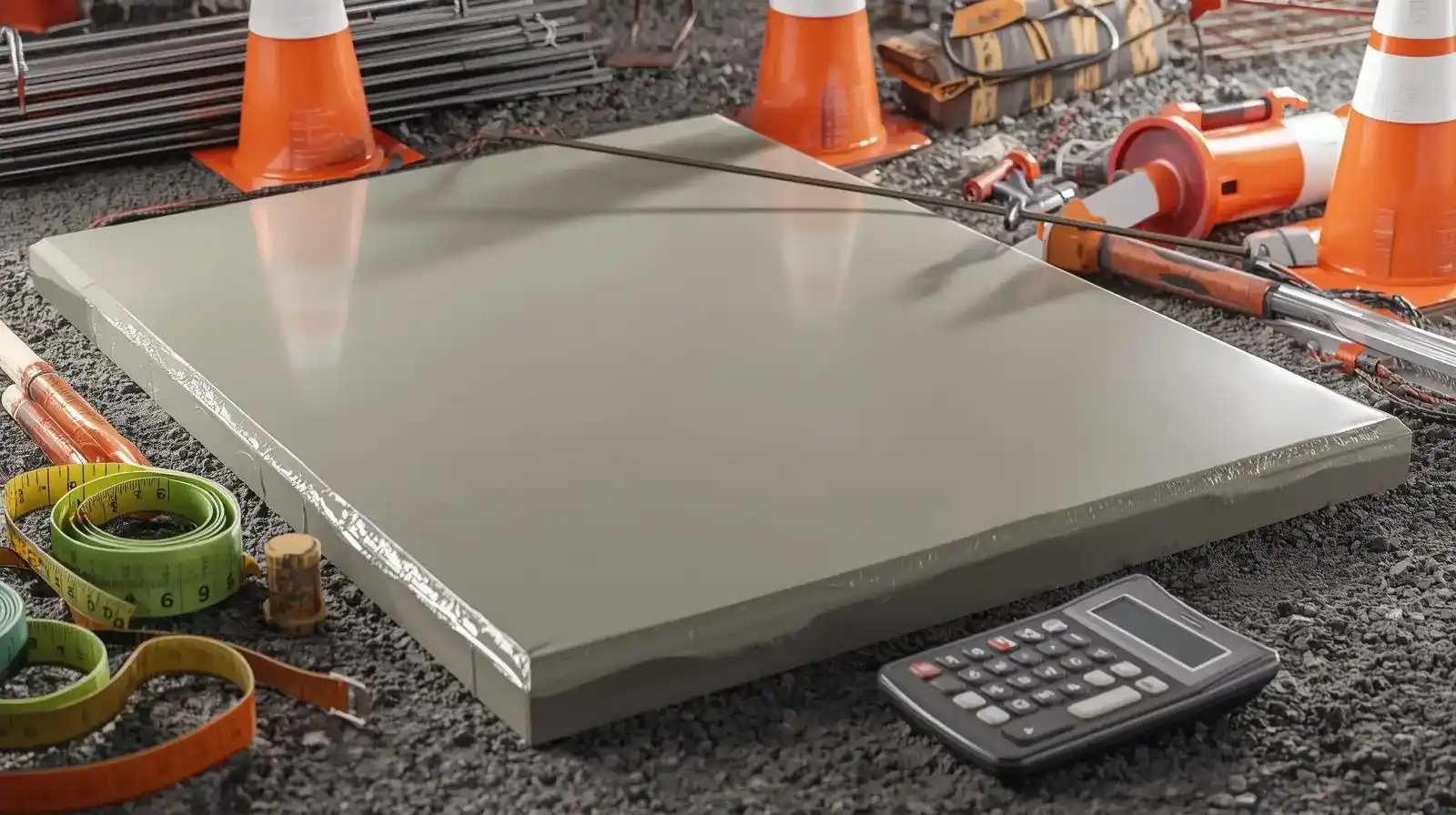
Concrete slabs are one of the most commonly used elements in construction. From residential driveways to commercial flooring, concrete slabs provide a durable and reliable foundation. Accurately knowing how to calculate concrete slab weight is crucial for structural safety, material estimation, and project budgeting.
This guide will teach you how to calculate concrete slab weight easily in 5 simple steps, using formulas, practical examples, and online calculators.
Step 1: How to Calculate Concrete Slab Weight – Understand the Importance
Knowing the weight of a concrete slab is essential because:
-
Structural Safety: Ensures foundations, beams, and supports can handle the load.
-
Material Estimation: Helps order the correct amount of concrete and avoid waste.
-
Cost Management: Accurate weight calculation reduces project costs.
-
Transportation Planning: Important for transporting pre-cast slabs or ready-mix concrete.
For fast calculations, try our Concrete Slab Weight Calculator.
Step 2: How to Calculate Concrete Slab Weight – Consider the Key Factors
Several factors influence slab weight:
2.1 Density of Concrete
-
Standard concrete: ~2400 kg/m³ (150 lb/ft³)
-
Lightweight concrete: 1600–2000 kg/m³
2.2 Slab Dimensions
-
Length (L), Width (W), Thickness (T)
2.3 Reinforcement Material
-
Steel rebar can add 2–5% extra weight, depending on design
2.4 Moisture Content
-
Freshly poured concrete is heavier due to water, reducing slightly after curing
Learn more about concrete densities from Portland Cement Association.
Step 3: Step-by-Step Guide – How to Calculate Concrete Slab Weight
The basic formula:
Weight (kg) = Volume × Density
Where:
-
Volume (m³) = Length × Width × Thickness
-
Density (kg/m³) = 2400 kg/m³ (standard concrete)
Measure Dimensions
Example:
-
Length = 5 m
-
Width = 4 m
-
Thickness = 0.2 m
Calculate Volume
Volume = L × W × T = 5 × 4 × 0.2 = 4 m³
Multiply by Density
Weight = 4 × 2400 = 9600 kg
So a 5×4 m slab with 0.2 m thickness weighs 9600 kg.
Step 3a: Imperial Unit Calculation
Weight (lb) = Volume (ft³) × Density (lb/ft³)
-
1 m³ ≈ 35.3147 ft³
-
Density = 150 lb/ft³
Example: 4 m³ = 141.26 ft³
Weight = 141.26 × 150 ≈ 21,189 lb
Use our Slab Weight Calculator Metric to Imperial Conversion for quick results.
Step 4: Using Online Calculators to Calculate Concrete Slab Weight
Manual calculations are accurate, but online calculators:
-
Save time
-
Reduce human error
-
Include reinforcement and density options
Recommended Calculator
-
Concrete Slab Weight Calculator – Input slab dimensions, density, and optional rebar weight
Step 5: Examples and Tips for Accurate Slab Weight Calculation
Example 1: Small Residential Slab
-
3 m × 3 m × 0.15 m → Volume = 1.35 m³
-
Weight = 1.35 × 2400 = 3240 kg
Example 2: Large Commercial Slab
-
10 m × 8 m × 0.25 m → Volume = 20 m³
-
Weight = 20 × 2400 = 48,000 kg
Example 3: Reinforced Slab
-
Add 5% rebar → Total Weight = 48,000 + 2400 = 50,400 kg
For reinforced concrete guidelines, see ACI Concrete Manual.
Common Mistakes to Avoid When Calculating Slab Weight
-
Incorrect Thickness Measurement – Always measure accurately
-
Ignoring Rebar Weight – Include reinforcement in calculations
-
Wrong Density Value – Use standard, lightweight, or high-strength density
-
Unit Conversion Errors – Double-check metric-to-imperial conversions
Using calculators minimizes errors and saves time.
Frequently Asked Questions (FAQs)
Q1: Can I calculate slab weight without a calculator?
Yes, use Weight = Length × Width × Thickness × Density, but online calculators are faster and more accurate.
Q2: Does reinforcement significantly affect weight?
Yes, steel rebar can add 2–5% depending on design.
Q3: Can I use lightweight concrete?
Yes, lightweight concrete (~1600–2000 kg/m³) produces a lighter slab.
Q4: How to convert slab weight to tons?
1 metric ton = 1000 kg. Divide slab weight by 1000 for tons.
Q5: Where can I find a free online slab weight calculator?
Use our Concrete Slab Weight Calculator for instant results.
Q6: Why is slab weight calculation important?
Accurate weight ensures structural safety, proper material ordering, and cost management.
Q7: Can I calculate the weight for non-rectangular slabs?
Yes, calculate the volume for the shape (circle, trapezoid, irregular) and multiply by density.
Conclusion: How to Calculate Concrete Slab Weight Without Errors
By following these 5 simple steps, you now know how to calculate concrete slab weight accurately and avoid costly mistakes. Proper calculation ensures structural safety, efficient material usage, and cost-effective construction projects.
Explore more useful calculators on our Material Calculators page.